Archive for the ‘Poetry’ Category

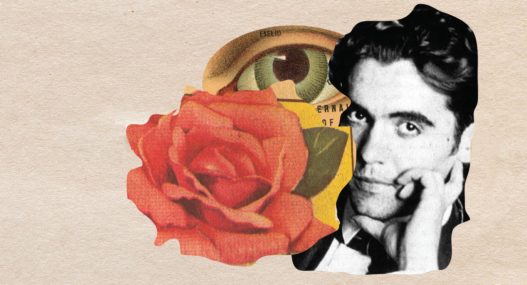
On Lorca’s Poet in New York

Thursday, April 18th, 2013

by Maureen N. McLane

What a strange, vital, careening book—what a book for now. Yet also, what a fascinating document of the early 20th century. A Poet in New York, “New York in a Poet,” as Lorca himself glossed it: this is clearly one of the great works of transnational modernism, a cracked Andalucían mirror held up to New York’s crazed, vibrant, and disgusting face. The best poetry is “news that stays news,” as Pound put it. This book seems to me news I can use—registering the skyscrapered canyons of the city, its savage underbelly everywhere humming with reptilian life (all those iguanas and crocodiles running around in the poems), the titanic fraudulence of Wall Street, the vomiting crowds of a Coney Island Sunday. (more…)

AWAYWARD

Thursday, April 11th, 2013

Averill Curdy on What Brought Her to Poetry

Wayward: difficult to control or predict; shortened from obsolete Middle English awayward, “turned away.”

I’ve kept a diary, more or less faithfully, for over 30 years. I’ve moved the expanding shelf of filled journals between various apartments in Seattle, and then to Texas, Missouri, Michigan, and finally to Chicago. I’ve copied favorite passages from my reading, noted the rare dream, and jotted down ideas, stray images, or lines for poems; I’ve paginated and indexed them. I mourned when my favorite notebook—an Exaclair sketchbook with 100 pages of 100-gram French paper that loved ink—was discontinued. Writing in one of these was happiness, small, but durable as the cup of coffee my husband makes for me each morning. But I never so much as glance at a single one of those diaries after writing the final words on its last page.

The summer I turned 25 my mother was dying of breast cancer. Long after she died, I broke the middle joint of my thumb fielding an easy ground ball at second base during a softball game. The doctor bent my thumb backwards from the break, binding it into position so that the tendon and joint would knit themselves back together, then sent me home with some Tylenol. That night the pain reduced the little vanities and injuries, desire, and self-regard of my identity to kindling. The next day I was able to get a prescription for codeine and the cessation of that pain was an experience of delicious release from bondage. Afterwards, I was able to think of what my mother must have endured without complaint as the cancer colonized her bones and soft tissues. (more…)

Girls and Dead Poets

Thursday, February 14th, 2013

by Dennis Mahoney

It’s 1990 and I’m a loser. Becoming a novelist hasn’t crossed my mind. I’m a high-school junior who’s shown some aptitude in art, and by aptitude I mean I’m better than classmates who don’t try at all. My art teacher is just happy I do the assignments instead of throwing Exact-o knives into the ceiling.

I had a creative impulse throughout my early life, fueled by supportive parents, Legos, and the original Star Wars trilogy. Relatives raved about my drawings. I got a spaceship illustration printed in the local paper during grade school. And I didn’t really want to be Luke or Han. I wanted to be George Lucas and create something awesome.

But I couldn’t be bothered to develop any skills. Mötley Crüe was big in my life, as were the Commodore 64 video games my friends and I swapped along our paper routes. I had bad hair, just shy of a bowl cut. Major cysts instead of zits. A soft, pale, jean-jacketed body. I’d never had a serious girlfriend because girls have standards, and because I kept thinking my luck might change, which is the best way to ensure it never, ever does. (more…)

Q & A: Rowan Ricardo Phillips with FSG Poet Lawrence Joseph

Thursday, June 7th, 2012

Rowan Ricardo Phillips, whose debut book of poetry, The Ground, published this week, recently sat down with fellow FSG poet Lawrence Joseph. We’re happy to share with you their remarkable discussion on the craft, translation, mythmaking, and–of course–Phillips’ stunning new work.

Lawrence Joseph: First of all, I want to say how much I like this book. In fact, I think it’s a masterpiece. Why the title The Ground?

Rowan Ricardo Phillips: Good morning… and thank you! As opposed to “the land” or “the floor” or “where you are” or “the street”, there’s something feral, archaic, and really part from ourselves in “the ground”. It’s the word we often relate with the ceremonial end of our physical selves—we’re buried, we tend to say, in the ground—and yet it also inhabits, in our English language at least, a point of progression: we build on things, and on ourselves, from the ground up. If you replace “ground” with “earth” in those two phrases they become too self-conscious and overly willful. Similarly, “the land” is a word almost entirely self-conscious of ownership and power. For example, switch “land” with “ground” in Frost’s “The Gift Outright” and you have a different poet. I should point out that none of these aforementioned words were candidates for the title of the book. The Ground came to me instinctively as I was working on through the poems. It was as insistent, like a pulse, and I wanted to capture the feel of that in the entire book, the way the ground pulsed in my imagination as I wrote. As you read through the book I’m hoping you feel the pulse of the ground in it, both as concept and character. It’s incredibly important for a poet to recognize and come to terms with his or her temperament—I can’t stress that enough—and my temperament left me not wanting to have a titular poem in the book. That’s not me. A representative poem for the book—that wasn’t where The Ground was heading; I could feel that strongly even in its earliest moments and movements. (more…)

Jorge Luis Borges: Borges and I

Tuesday, May 17th, 2011

This newly translated piece by Jorge Luis Borges appears in The FSG Book of Twentieth-Century Latin American Poetry. Ilan Stavans, the book’s editor and the translator of “Borges and I,” stopped by the FSG offices to record the piece in Spanish and English for us:

Audio clip: Adobe Flash Player (version 9 or above) is required to play this audio clip. Download the latest version here. You also need to have JavaScript enabled in your browser.

The other one, Borges, is to whom things happen. I walk through Buenos Aires, stop, maybe a bit mechanically, to look at the arch of an entrance way and a grillwork door; I have news from Borges by mail or when I see his name in a list of professors or in a biographical dictionary. I like hourglasses, maps, 18th-century typography, the taste of coffee, and Stevenson’s prose; the other shares those preferences but with a vanity that turns them into an actor’s attributes. It would be an exaggeration to affirm that our relationship is hostile; I live, I let myself live, so that Borges can plot his literature and that literature justifies me. It doesn’t cost me anything to confess he has achieved a few valid pages, but those pages can’t save me, perhaps because what’s good no longer belongs to anyone, not even to the other, but to language and traditions. (more…)

Poetry by Roberto Bolaño from BOMB Magazine

Tuesday, March 15th, 2011

We’ve partnered with the good folks at BOMB Magazine to offer our subscribers an exclusive sneak peak of Roberto Bolaño’s poetry collection, Tres (New Directions), excerpted in their upcoming spring issue. To read Poem #31, please subscribe. This will be online for only a short time, and BOMB #115 will be on newsstands later this month.

-Ryan Chapman

Celebrating the Elizabeth Bishop Centenary

Monday, February 14th, 2011

On February 8th, over a thousand people turned out to celebrate the 100th anniversary of the poet Elizabeth Bishop at the Cooper Union in New York. Paul Muldoon and Alice Quinn read selections from the New Yorker correspondence, and twenty poets shared their favorite Bishop poems.
(more…)

Editor & Author: Jonathan Galassi and Gjertrud Schnackenberg

Sunday, January 16th, 2011

Jonathan GalassiHeavenly Questions, Gjertrud Schnackenberg’s recently published sixth book of poems, is a remarkably moving and, perhaps surprisingly, exhilarating work, given that it is an elegy for the poet’s late husband, the philosopher Robert Nozick, who died in 2002. In the exchange that follows, I ask Trude to talk about some of the sources and inspirations that inform this complex and deeply beautiful book.

-Jonathan Galassi, President and Publisher of FSG
(more…)

The Archives: Mark Strand Reads Joseph Brodsky

Wednesday, December 15th, 2010

Joseph Brodsky © Nancy Crampton

We’ve noticed a surge of interest in Nobel laureate Joseph Brodsky centered around the recent New York Times article “Venice in Winter” and the use of poetry as travel guide.

The following two poems were recorded at the Donnell Library Center on December 18, 1980. The poet Mark Strand reads in English, and Joseph Brodsky reads from the Russian.

“A Part of Speech (as for the stars they are always on)”

Audio clip: Adobe Flash Player (version 9 or above) is required to play this audio clip. Download the latest version here. You also need to have JavaScript enabled in your browser.

“A Season”

Audio clip: Adobe Flash Player (version 9 or above) is required to play this audio clip. Download the latest version here. You also need to have JavaScript enabled in your browser.

Courtesy of the Academy of American Poets (www.poets.org) and Mark Strand.

Wikileaks and War Poetry

Tuesday, November 16th, 2010

Daniel Swift is the author of Bomber County: The Poetry of a Lost Pilot’s War.

Photograph © by Deborah Copaken Kogan

On October 30th, at a press conference in London, Julian Assange—the founder of Wikileaks—announced the leak of 391,832 secret military documents about the war in Iraq. This represents, he said, “the most comprehensive and detailed account of any war ever to have entered the public record.” Here are tortures, newly revealed; here are awful rates of civilian deaths (perhaps 66,000)—and all presented in clipped, oddly formal, occasionally redacted fragments (here, for example, is the record of a friendly-fire incident from January 2008: “CAV REPORTS THAT SMALL ARMS FIRE ENSUED BECAUSE OF A DISAGREEMENT BETWEEN CLC AND IA. NO ENEMY INVOLVEMENT”).

(more…)

Jonathan Galassi on Translating Giacomo Leopardi

Tuesday, November 16th, 2010

Jonathan GalassiAs this glimpse at the proofs of my versions of Leopardi’s Canti suggests, a translation, like an original poem, is never finished, only abandoned. And that remains true even after the book is published—I’ve already started collected “improvements” for a future printing.

There’s usually a way to say what needs to be said more concisely, more pithily, more beautifully. That’s why I’ve found translation over the years to have been an incredible education in writing.

(more…)

New Poetry by Eliza Griswold

Sunday, August 15th, 2010

You may know Eliza Griswold from her journalism at The Atlantic, The New Yorker, or The New York Times Magazine. Perhaps you’ve heard the buzz around her first nonfiction work The Tenth Parallel: Dispatches from the Fault Line Between Christianity and Islam.

Griswold is also a noted poet; FSG published her collection Wideawake Field in 2007. There is an unsurprising overlap between her journalism and her verse: both reflect her itinerant nature and an engagement with other cultures. The three poems presented here are all previously unpublished.

(more…)