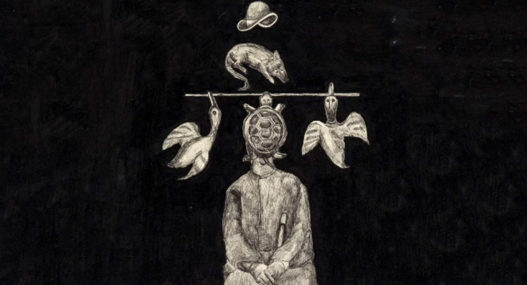
Tupelo Hassman graduated from Columbia’s MFA program. Her writing has been published in Paper Street Press, The Portland Review Literary Journal, Tantalum, We Still Like, ZYZZYVA, and by 100WordStory.org, FiveChapters.com, and Invisible City Audio Tours. Tupelo will be filming Girlchild‘s book tour for a short documentary, “Hardbound: A Novel’s Life on the Road.” Her website is www.tupelohassman.com.
Girl Scouts are inexhaustible creatures, and so it shouldn’t have surprised me to find precisely the advice I needed today in my friend Rory Dawn’s tired old copy of the Girl Scout Handbook. An entire section detailing “How to Introduce Your Friends” waved at me from the Handbook’s index, and I breathed a sigh of relief.
Friend, I’d like you to meet someone.
“That’s very forward,” you might think, “we’ve only just met. I don’t even know how to pronounce your name!” And to yourself, because you are invariably polite, “What is a Tupelo?”
But we are now acquainted, via our mutual friends and hosts, Farrar, Straus and Giroux. You’ve caught me wondering where I’m meant to deposit the sword-handled toothpicks at the hors d’oeuvres table at this monthly cocktail party that is the Work in Progress. I’ve admired your wrinkle-free ease in conversation and put down my growing collection of petite plastic swords to shake your hand. We’ve shared the awkward “let’s be alone at the party together” moment that has birthed many a friendship, and in that spirit, I’d like to introduce you to Rory Dawn. (more…)
T. M. Wolf is the author of Sound, which will be published by Faber & Faber in April. He is twenty-nine, grew up on the New Jersey Shore, and he has written for a variety of music publications, particularly on hip-hop. He recently graduated from Yale Law School. You can follow him on Twitter @tom_tm_wolf.
You have a tremendous academic record and this is something of a departure from your studies. How and why did you come to write this novel?
When I was in the early stages of writing Sound (2005 to 2008), I was bouncing around a lot, basically moving from one school and one academic program to the next. I was working very hard trying to “find” something (I’m still not quite sure what) and learning a lot, but I still felt like I was missing something (again, I’m not sure exactly what). At the time—and I still think this is true—fiction seemed like a more versatile, and maybe more productive, way to explore ideas that my academic work kept kicking up but that academic methods didn’t seem flexible enough to address. These were all questions of experience, I guess: what it feels like to be human, how our minds work, how we relate to other people, what it’s like to be answer-oriented in a world that’s chaotic and doesn’t yield answers all that readily. (more…)
Jeffrey Eugenides stopped by the FSG offices a couple weeks ago, in advance of his book tour for The Marriage Plot. We used the opportunity to let his Facebook fans ask a few questions, some of which are featured in the video below.
Q. In the introduction for My Mistress’s Sparrow Is Dead you speak of the concept of a “love story” and provide a selection of short stories in that vein. Which novels do you believe also fit the mold of a “love story,” and did they influence your writing of The Marriage Plot? (more…)
Paul Murray is the author, most recently, of Skippy Dies, due in paperback later this month. He spoke by telephone with his editor, Faber and Faber publisher Mitzi Angel, about his next novel, reading Proust, and what stops boys from putting dental floss up their noses.
Mitzi Angel: So I heard the big news about David Cameron’s holiday reading.
Paul Murray: Yes, my agent texted me at seven in the morning last week to say she’d heard David Cameron had brought Skippy Dies on holiday. The Daily Mailhad the headline CAMERON BRINGS DARK TALE OF DRUGS AND PORN ON HOLIDAY, which was cool.
Angel: A Dark Tale of Drugs and Porn! Maybe that’s how we should have described the book in our catalog! Was Skippy the only book he took on holiday with him?
Murray: He took Jerusalem: The Biography by Simon Sebag Montefiore, which sounded to me like your classic aspirational holiday read that never makes it out of the suitcase. But I don’t know how much of Skippy he read, either, because a day or two later the protests and looting broke out and he had to cut short his holiday. Though I liked to imagine him sneakily reading it under the table at COBRA meetings.
To mark the paperback publication of Role Models, John Waters answered a few questions about taste, the art world, and death. The interview was conducted over the phone just before Waters’s trips to the Walker Art Center in Minnesota and the Bonnaroo music festival in Tennessee.
-Ryan Chapman
Chapman: What is taste, and what do people mean when they say something is in bad taste?
John Waters: Taste is style, and to know bad taste of course you have to have been taught the rules of the tyranny of good taste so you can yearn to break them. I thank my mother every day for teaching me proper table manners—which fork to use, all that stuff—even though it lead to a career that humiliated and embarrassed her. But she’s grown quite used to it and proud over the years.
You have to have some taste. I think Diana Vreeland said bad taste is better than no taste. Taste is how you describe yourself. It’s how you present yourself to the world. It’s about humor . . . Everyone is a curator of their own life: what they have around them, what they read, what they watch. So everybody, no matter what—even the most deranged homeless person—has taste. They know which bottle they want to collect more, which shopping cart they want to fill. Everyone has taste and it’s how you define yourself against the world. (more…)
This fall FSG will publish Parallel Stories by acclaimed Hungarian author Péter Nádas. Editor Elisabeth Sifton writes, “After his last novel, A Book of Memories, appeared in English in 1997, many critics and readers agreed with Susan Sontag’s assessment that it was the greatest novel written in postwar Europe. But Nádas was already moving past that signal achievement. And now we can see how Parallel Stories—which took eighteen years to write, Nádas has said, and appeared in Budapest in 2005—extends and deepens the scope of his fiction, both in historical terms and in the most intimate, hidden terms of body and soul. The multilevel narrative reaches back to the 1930s, thickens in the crisis seasons of 1944–45, 1956, and 1961, and thrusts forward to 1989; and at every point we experience the intense and daring ways that the men and women he so memorably creates live through or transcend, create or deny the brutalities of their strife-torn times. This is a great novel about the twentieth century and, with its dazzling formal innovations and daring candor, a postmodern novel for the twenty-first.” (more…)
Solar System for iPad is one of the few unqualified successes in the nascent, hybrid area of books-as-apps (or is it enhanced ebooks? New media texts?). Author Marcus Chown graciously and candidly answered a few questions about how such a unique property came about. Chown is cosmology consultant of New Scientist. His books include We Need To Talk About Kelvin, shortlisted for the 2010 Royal Society Book Prize. In the US, the book is published by FSG as The Matchbox That Ate a Forty-Ton Truck.
-Ryan Chapman
Chapman: How did the app come about?
Marcus Chown: My editor at Faber—a UK publisher with strong connection with FSG, incidentally—said: “Would you be interested in doing an iPad app based on one of your popular science books?” It was early 2010. The iPad had yet to be launched but there was “buzz” surrounding Apple’s device. I had never had an illustrated version of one of my books such as Quantum Theory Cannot Hurt You (The Quantum Zoo in the US) so was keen to do one. It therefore me took less than ten seconds to say to Henry, as coolly as I could: “Yes, I’m interested.”
A few weeks’ later Henry phoned to say, by Googling, he had found a company called Touchpress, which had expertise in developing iPad apps. Touchpress was founded by Max Whitby, a former producer of Nova/Horizon; his friend from Oxford University days, Stephen Wolfram, multimillionaire creator of the computer language “Mathematica”; and American science writer Theo Gray. Gray had written the text for a stunningly beautiful, glossy book on the chemical elements called, unsurprisingly, The Elements.
Greg Lindsay is a journalist whose writing has appeared in publications like Time, Fast Company, and recently the Wall Street Journal and the New York Times. His new book Aerotropolis: The Way We’ll Live Next (co-written with John D. Kasarda) is a fascinating look at the future of cities in an increasingly connected world. To mark its publication this month, Lindsay hopped on Skype with Geoff Manaugh of BLDGBLOG, to talk about Aerotropolis, global urbanism, the role of the architect, and the internet’s place in architectural criticism today. Work in Progress is bringing you the second part of this conversation; you can head over to BLDGBLOG to read the first part.
Geoff Manaugh is the founder and author of BLDGBLOG, one of the best architecture and design blogs out there today. He is a former senior editor of Dwell magazine, a contributing editor at Wired UK, and the author of The BLDGBLOG Book, one of Amazon’s 100 Best of 2009.(more…)
Rahul Bhattacharya, who lives in New Delhi, is the author of Pundits from Pakistan, a book of reportage, and The Sly Company of People Who Care, a first novel to be published by FSG in May. He answers some questions about the desire to escape home, the visceral energy of Creole, and V.S Naipaul.
-Eric Chinski, Editor in Chief
Chinski: Your first book was a work of reportage on the India-Pakistan cricket rivalry. Why did you decide to turn next to writing your first novel?
Rahul Bhattacharya: I didn’t, actually. The form came afterward, at the moment of writing. What I was responding to was the impulse to get away. It’s a terribly seductive impulse: What are the consequences? In part I was getting away from writing about cricket as well. But I’m grateful to cricket-writing, without which I may not ever have had a chance to visit the Caribbean.
As a special offer to Work in Progress subscribers, our friends at BOMB Magazine are offering their complete online interview with controversial French writer Tristan Garcia. This will be available only for a short time.
Garcia’s novel, Hate: A Romance, won the prestigious Prix de Flore. He has previously written a book of philosophy.
-Ryan Chapman
“To me, a novel is specifically defined as an experience—concerning morality and knowledge—that takes the shape of a story. Like any experience, it runs the risk of having imperfect results, but it must always allow us to know a little more than what we already knew, than what we have personally experimented with in our own life. It is truly a moral adventure. The experience must particularly—and this is the specific power of the novel—give us the means to escape the limits of our morality (individual, familial, national, of class, or species) to adopt that of an Other (the character) who can truly begin to exist there where our own actions end.”
Heavenly Questions, Gjertrud Schnackenberg’s recently published sixth book of poems, is a remarkably moving and, perhaps surprisingly, exhilarating work, given that it is an elegy for the poet’s late husband, the philosopher Robert Nozick, who died in 2002. In the exchange that follows, I ask Trude to talk about some of the sources and inspirations that inform this complex and deeply beautiful book.
-Jonathan Galassi, President and Publisher of FSG (more…)
To coincide with David Levithan’s The Lover’s Dictionary, he’s asking readers to create their own entries in the style of the book. Here’s a preview of what we mean:
When the 2010 Nobel Prize for Literature announcement went out last week, we were thrilled they named our author Mario Varga Llosa. I reached out to two of his translators for their thoughts.
Edith Grossman is an award-winning translator of Gabriel García Márquez, Julián Rios, and Álvaro Mutis, among others. Her 2003 translation of Cervantes’ Don Quixote is widely acclaimed as one of the best translations from the Spanish in recent years.
Natasha Wimmer is best known for her translation of Roberto Bolaño’s The Savage Detectives and 2666. She has also translated Pedro Juan Gutiérrez’s Dirty Havana Trilogy.
+ + +
Chapman: How did you first discover Mario Vargas Llosa’s work?
Edith Grossman: I first discovered his work in graduate school, when I was reading works of the Latin American Boom—Vargas Llosa, Fuentes, García Márquez, Rulfo, Cortázar, and so forth.
Chapman: How did you come to translate his books in the United States?
Grossman: I was approached by FSG to translate Death in the Andes, the first book of his I worked on. I had met him a few times before that in New York, at talks and readings. (more…)
It may seem foolish to start a literary journal at a time when fewer people are reading books, and doomsayers fill column inches with “death of literature” jeremiads. But Andy Hunter and Scott Lindenbaum have developed a new approach that seems to work: find great short fiction and get it to the people wherever they are. They’re also producing a number of more experimental approaches to narrative and technology that… well, we’ll let Andy tell you himself.
-Ryan Chapman
Chapman: Give us a brief overview of Electric Literature and how you distribute the work to readers.
Andy Hunter: Electric Literature was created as an optimistic response to the fear many were feeling in the face of a changing medium: what the obsolescence of the printed word meant, specifically, for literary writing. (more…)
Chris Adrian, the author of two novels and a short-story collection, is one of our most interesting young fiction writers—he is also a practicing pediatrician, a fellow in pediatric hematology-oncology, and a student at divinity school. Rivka Galchen, a novelist who also has a background in medicine, talks with Chris about his forthcoming novel, The Great Night, a magical retelling of A Midsummer Night’s Dream, set in contemporary San Francisco. In the course of their conversation, they discuss talking bagels, the cult sci-fi movie “Soylent Green,” and how to write convincingly about fairies. Rivka and Chris were both recently chosen for the New Yorker’s “20 Under 40” list.
-Eric Chinski, Editor in Chief
Galchen: Who and what lives and happens in The Great Night?
Adrian: The Great Night is a retelling of Shakespeare’s A Midsummer Night’s Dream set in Buena Vista Park in San Francisco in the summer of 2008. Three people—two men and a woman—get lost in the park on their way to a party and have a common adventure involving fairies, a monster, and the ghosts of their recently deceased romantic relationships. Around and in between the action of this main story, Titania struggles in the aftermath of the death of her adopted son and the subsequent breakdown of her thousand-year marriage to Oberon, and a group of homeless people stage a musical production of Soylent Green (called Soylent Green!) for the benefit of the evil mayor of San Francisco. (more…)
Dan Bejar is something of a musical polymath. He releases albums as the front man for Destroyer while collaborating with the New Pornographers and playing as a member of indie supergroup Swan Lake. Bejar’s music contains myriad allusions to pop songs and contemporary literature, in addition to tongue-in-cheek wordplay (“She had the best legs in a business built for kicks”). He’s also the only musician I know of with a song about a certain publishing house.
—Ryan Chapman
Chapman: I have to get this out of the way: Is there a story behind naming the song “Farrar, Straus and Giroux (Sea of Tears)”?
Dan Bejar: Ten years ago I was thinking of making an album whose song titles were all named after established American publishing houses. I don’t know why, it was maybe based on the idea of rejection, or social failure. Also, they all sounded so archaic to me, like books themselves, and therefore pretty mysterious. I was into enclosed sets of terms back then, though I was coming out of it, which is probably why I ditched the idea. The album ended up being called Streethawk: A Seduction, and the song titles were all over place, though FS&G stuck. I now just generally call it by its parenthetical title “(Sea of Tears).” I guess ten years later I like things in their simplest, saddest terms. Still think Farrar, Straus and Giroux rolls off the tongue real pretty, though.
Audio: “Farrar, Straus and Giroux (Sea of Tears)”
Audio clip: Adobe Flash Player (version 9 or above) is required to play this audio clip. Download the latest version here. You also need to have JavaScript enabled in your browser.
(Courtesy of Merge Records)
Chapman: There are a handful of musicians who strike fans as “literary,” whatever that word means in this context. You quote Ezra Pound, Albert Camus, and others in your songs, and the settings recall Graham Greene, Roberto Bolaño, even Borges. Are there certain literary antecedents you’d like to discuss? Put another way, do you have writers you read and reread?
I sat down with three designers over coffee and muffins to talk about how they came to their jobs, and where they think the industry is headed. Susan Mitchell is Senior Vice President and Art Director at FSG; Charlotte Strick is Art Director, also at FSG; and Henry Sene Yee is Creative Director at Picador.
—Ryan Chapman, Online Marketing Manager
“I’m not just here to create something beautiful. Sometimes I’m here to be a plumber.”